Researching Yiddish penny songs (tenement song broadsides of theater and variety show songs, 1895-1925)
About this project ♦ ♦ About Jane Peppler
List of the still-lost songs: do you know any of them?
Search the blog:

Tuesday, January 26, 2021

Shtoyst zikh on (Figure it out yourself) - Solomon Small sang it in 1910 and I sang it today.

UPDATE: The lyrics for two verses of this song were found in Solomon Small's own magazine of (primarily his own) Yiddish theater song lyrics, but it took a while to find the melody (on the recording you'll find below, which I bought on eBay). Updating because four years ago I had somehow mislaid my own version so today when I wanted to write it up for my "Yiddish pour tous" series, I had to sing it over again.

Also, Mordkhe Miller and Ri Turner helped me figure out the words to the third verse. I guess it was a little too risque to be printed on the sheet music. The music teacher and his beautiful student work on the piano, the verb is tsimblen which means play the cimbalom, strike the cymbals; make a racket, play boisterous music; thrash, beat and it sometimes is used for people beating on each other and it also is a rough synonym for banging, which would have been the cruder translation. Anyway, here's my recording from this morning:


And also to point out this song has the same "nudge nudge wink wink" theme as a song I posted in December: Dos iberike farshteyt aleyn (and the rest, you understand).

Now back to the real thing: I found the Smulewitz record on ebay. What a great orchestra! The song is by Arnold Perlmutter and Herman Wohl with words by Louis Gilrod. The singer is composer and performer Solomon Small (originally Solomon Smulewitz) but the song was originally out in 1909 featuring Bessie Thomashefsky - it's from Boris Thomashefsky's show Dos pintele yid (or as it says on the sheet music Das pintele yud). You'll find it spelled Shtoist sich on or Shtoist zikh on. I love this recording!


I'm sad the third verse (about, I assume, a lecherous piano teacher) is not printed in the sheet music. If anybody wants to figure it out I'd be grateful. Email me if you do.

The YIVO transliteration of the Yiddish and my translation after the jump.


>>>>>READ MORE >>>>>

Labels: , , , , , , ,

Wednesday, August 12, 2020

Sweet Rosie O'Grady: Yiddish Parody by David Meyerowitz of the famous Irish-American song for St Patrick's Day

UPDATE: I know there are a lot of people interested in cross-dressing performers of the vaudeville and music hall stage who will enjoy this picture I just found of Maude Nugent as a young woman:

Here's the track from our cd Yiddish Ragtime.


Here is another song from Lider Magazin - a Yiddish version of Maude Nugent's Tin Pan Alley Irish-American hit song of 1896. (You can hear her singing the original song on Youtube.)

Last March Randy Kloko, the bass who has sung with me on so many of these Yiddish projects, made an unexpected visit from Florida and he sang on this in time for St Patrick's Day 2019. He is a barbershop quartet expert and added the correct flair! Then we were able to put it on our new cd Yiddish Ragtime.

If you have been looking for a Jewish song to sing for St Patrick's Day, here it is.

Note that in the third verse it is revealed that Rosie is disrespected in society. I believe she is probably a chorus girl or an actress, it was a familiar trope of the day (actually still true) that boys of respectable families would fall in love with show biz dames.


Transliteration and translation from the Yiddish after the jump.


>>>>>READ MORE >>>>>

Labels: , , , ,

Sunday, June 28, 2020

Mentshn-freser: What tuberculosis, polio, and war have in common.

UPDATE: Until recently I was very disappointed that nobody was picking up on these fascinating songs. But three years after I wrote this blog post, Daniel Kahn and Sveta Kundish did a bangup job on this one! Have a listen: Mentshn-fresser (1916 Yiddish Pandemic Ballad) Sveta Kundish & Daniel Kahn.

And now back to the original post:

Wow, it's been three months since I put up a song. There was a time I was putting one up almost every day. Truth is, since the election I have been so disheartened I hardly ever talk, let alone sing. There are times I think music is over for me. I just can't bear the world right now. So I sound rusty but it will have to do.

This song has been in the "to-do folder" for a long time. Mark Slobin discussed it in his book, Tenement Songs, thirty-odd years ago. I recorded three of the four verses today: the first about tuberculosis, the second about polio, and the last is about war. All these things are devourers of mankind. Fresn is greedy, insatiable eating - gobbling or hoovering when it comes to food.

Solomon Smulewitz published this song, spelled Menshen-fresser, in 1916. I've given the transliteration used in the sheet music on the video because I think it's important for Yiddish students to know what wide varieties of orthography we have to endure when searching for songs. There was a word here I did not know, laykhes or leykhes. I asked on Facebook and the only two people who answered me both suggested it is a typo for laybes, so that's what I went with. Enjoy the sprinkling of Germanic words used in Yiddish songs around the turn of the century.


Words and translation after the jump

>>>>>READ MORE >>>>>

Labels: , , , , , ,

Friday, August 2, 2019

Di matbeye - Yiddish theater song of 1908 - די מטבעה

UPDATE: In March I wondered if this song were lost forever. It's a wonderful Yiddish take on "If You Ain't Got That Do-Re-Mi" !

Happily Lorin Sklamberg and Eléonore Biezunski at the YIVO Sound Archive found a recording of Solomon Smulewitz singing this song, his own composition, and I liked it so much we put it on our Yiddish Ragtime album even though it has nothing in common with the other songs. It is the only natively Yiddish composition on the disk.


דיא מטבעה
I originally found it in the Solomon Smulewitz publication Der teater zinger דער טעאַטער  זינגער

Click the image for a larger view.

It says at the top of the page, Gezungen fun Mr Katzman un fun Madam Raynhart.
געזונגען פֿון מר. קאַטזמאַן און פֿון מאַדאַם רײנהאַרט

Perhaps these are Jacob Katzman and Fannie Reinhart.

I love everything about this song, from its snide and discouraging tone to its dark advice and its interesting, long tune. But my favorite part is the Question-and-Answer period. When I recorded it with Randy Kloko I said: let's have those answers sound like they came from on high via the Magic Eight Ball.


Transliteration and translation from the Yiddish after the jump.


>>>>>READ MORE >>>>>

Labels: , , , , , , ,

Thursday, August 1, 2019

Nit ales iz gold vos shaynt (All That Glitters Is Not Gold) by Isaac Reingold, 1894 Yiddish vaudeville song.

UPDATE: Replaced video with the track from our new cd Yiddish Ragtime


Today's song is Nit ales iz gold vos shaynt, which is most obviously translated as "All that glitters is not gold," as Shakespeare said. But there's word play in the Yiddish title - the verb shaynen does means to shine, but it also means to seem or to appear to be. So literally this would be "Not everything is gold that shines" AND "Not everything is gold that appears to be gold."

The parody was written by Isaac Reingold, who's authored many of the lyrics featured here. You'll find him lauded online as the "Bard of the West" - he lived in Chicago when he came over from Europe. He worked in sweatshops, wrote songs, drank too much, and died in 1903 at the age of 30. I think the world broke his heart.

He set his bitter text to the American popular song "Johnny, My Old Friend John," published in 1894. The composer and lyricist was William Courtright, and in his six verses he reminds his friend of times gone by. Eventually we realize that the two friends went off to war but while the narrator made it back, Johnny now is lying somewhere under the snow.

Randy Kloko sings with me on the choruses and Jack Herrick generously emailed me a guitar track when I wailed to him that my piano playing is so deadly boring and elementary even I can't stand to listen to it. Thanks Jack!

Translation and transliteration after the jump.

>>>>>READ MORE >>>>>

Labels: , , ,

Sunday, February 10, 2019

Mener, mener - written by Oskar Solomonescu for Pepi Littman

UPDATE: In a collection from YIVO of publications called Lider Magazin (sent to me by Vivi Lachs) I found another set of lyrics for this song ("sung by Madame Finkel"). If anybody cares I'll post a translation. Here it is, click for a larger view.


This tune was supposedly from a Goldfaden operetta called "Bais Duwed" of which I can't find mention online. I found the lyrics, along with Der Tsiferblat, at Harvard -- written out longhand in Yiddish cursive by the composer, Oscar Solomonescu, and notated: for Pepi Littman, New York. And what a great song it is! I just can't believe this amazing tune, found for me by Michael Aylward, sung here by the magnificent Frank Seiden: Menner Menner, von Bais Duwed

And here's my version, sung this morning (the first time I've tried singing since our wretched election).


The composer, Osias Solomonescu, was born April 1869 in Yasi, Romania, to poor, Orthodox parents. Orphaned early, and penniless, but blessed with a beautiful voice, he found a home in some Romanian Yiddish theater troupe, where he sang in the chorus and played children's roles. His first adult role was Benyominl in Goldfaden's "Podriatshik" and after that he began playing comic roles, especially dressing as and playing a woman. He came to American in 1901 and played at the Eldorado. He also worked as a stage manager and "episode actor" in the Bronx Prospect Theater and in Philadelphia's Orchard Street Theater.

He wrote many theater songs most of which he sang himself. While still in Romania he translated the one act "The Red Trousers," which was later shown in Yiddish variety houses. Zylberzweig: "Solomonescu was unique in the Yiddish actors' world with his humorous letters, in which he described that era of the Yiddish theater." I'll have to look for that.

I think it's quite interesting that Solomonescu -- an actor known for playing women's roles in drag --  wrote these two songs for Pepi, an actress known for playing men's roles in drag (or at least, she played women pretending to be men). Quite modern.

Back to Frank Seiden (of whom I have not found a picture) -- he was one of the earliest Yiddish recording artists in America. I love his records even though they're very scratchy. Peter Nahon via MachineWhisperer.com avers that Seiden "led a wild life, winning a bar in New York's bowery during a poker game and tending bar there after his recording career was over."

One sees at ancestry.com that he was born in 1861 or 1862 in Austria/Galicia, immigrated in 1876 and was naturalized in 1886. He had one wife, Rachael, and four children: Jacob, Eva, Amalia/Mary, Joseph. He was listed in 1900 in Manhattan as a phonograph dealer, in 1905 in Brooklyn as an actor, in 1910 as "Vaudeville" in 1920 he was retired or unemployed. He was perhaps the Frank Seiden who died September 1926 and is buried at Mount Hebron cemetery in Flushing, Queens.

I hope some descendant will get in touch at some point and email me his picture!

Words and translation after the jump.

>>>>>READ MORE >>>>>

Labels: , , , ,

Wednesday, November 28, 2018

Reb Yidl, gib gelt! (Mr. Jew, give money!) - a song for exhorting the synagogue congregation to pay up.

UPDATE: Searching the Florida Atlantic University Yiddish music collection using just the term "Reb" (because all other words in this title could be spelled in other ways) I found a recording of the song, sung by G. Z. Weismann: Reb Jüdel gib Geld

The sheet music for this song (spelled "Reb Yudel gib gelt") came out in 1905 and as you see, the song was sung with great success by Rosa Klug at the Peoples' Music Hall. Music J. Davidoff, words A. Mesco [now I know he was Adam Mesco], arranged by Joseph Rumshinsky.

The National Library of Israel has a 78 of Pepi and Moritz Weinberg singing this song, but of course, you can't listen to it unless you fly to Jerusalem. 

When I first saw this text, I thought it was a sincere exhortation to pious Jews, saying that if you want the good things of Jewish culture and religion, you must pay what they're worth. But towards the end of the song the sarcasm becomes more evident, and frume yidn of my acquaintance assure me this is a tongue and cheek message: in the Jewish community nothing comes for free even if it should.

There are two slightly different verses on the sheet music.

Click below to hear the song as I recorded it today:


For sheet music and/or performances contact me: jane@mappamundi.com

Labels: , ,

Tuesday, May 29, 2018

New digital-only cd of Yiddish Penny Songs from the turn of the twentieth century: Opgenarte velt

As you know I chug along recording rare songs as my mental state allows - since the advent of our current US regime it's been substantially more difficult and for several months I was so depressed I couldn't talk, let alone sing. Still, the pile of songs built up and yesterday I compiled two cds. Here is the first, Opgenarte Velt (Deluded World). Only $7 and comes with 18-page liner notes pdf file with the transliterated Yiddish lyrics and English translation. Click on picture to visit and listen.


Contents (all these songs have appeared on the blog):

1. Shtek arayn (Put 'er there!) 03:22
2. Uptown, Downtown 01:08
3. Mener, mener! (Men, men!) 04:14
4. Di opgenarte velt (The Deluded World) 02:58
5. A mentsh zolstu nor zayn (A mentsh zol men zayn) (Be a decent person) 03:19
6. Eylu voeylu (A Drinking Song) 02:33
7. In hundert yor arum (100 years from now) 04:08
8. A mentsh ken dokh makhn a mol a toes (A person can sometimes make a mistake) 02:32
9. Vos kh'hob gevolt hob ikh oysgefirt (What I wanted, I got) 02:35
10. Alts far gelt (Everything For Money) 02:44
11. Di zibn boarders (The Seven Boarders) 04:42
12. Mentshn-freser (Devourer of People) 05:02


For sheet music and/or performances contact me: jane@mappamundi.com

Labels: , , , , , , , , , , , , , , , , ,

Tuesday, May 22, 2018

Ven ikh zol vern president (If I Become President) 1904 Yiddish theater song

I couldn't find much information about this song, which is on the Library of Congress website. It's from the 1904 show "The Lodge President" דער לאָדזשען פּרעזידענט by that shund mayster Professor Horowitz, about whom I've written before.

Arnold Perlmutter and Herman Wohl wrote the song, which as usual is full of Yinglish. Lorin Sklamberg solved the oddest mystery, Fan Pleve ot dem Soine Yssrul, by pointing me to Wikipedia:

Vyacheslav Konstantinovich von Plehve 1846-1904 was the director of Imperial Russia's police and later Minister of the Interior. ... After he did nothing to prevent a bloody wave of anti-Jewish violence in 1903, the known double agent Yevno Azef decided not to inform on the SR plans to kill Plehve. He survived one attack in 1903 and two in 1904 before the Socialist-Revolutionary Combat Group succeeded. On 28 July 1904, a bomb was thrown into Plehve's horse-drawn carriage by Yegor Sazonov, on his weekly audience with the Tsar at Izmailovsky Prospekt in Saint Petersburg, killing him at 58.

So, note that von Plehve died the very year this song mentioned him!

I used the original transliteration from the sheet music in the video. You can see if you agree about the guesses I made. Here it is, recorded this morning. Something strange happened to the keyboard track.


Lyrics and translation after the jump.

>>>>>READ MORE >>>>>

Labels: , , , , , , , , , , ,

Tuesday, December 26, 2017

Mayn vayb iz in der country, hurray! Yiddish theater song recorded by William Schwartz in 1919

Feast your eyes on the dishy singer William Schwartz. You can read about him at a post about one of his other songs: Oy oy di vayber. He's also the singer of Hit aykh, meydlekh!.

AKA Mein Weib is in der Country Huray! and Mein Weib is in der Country Hurray!

For decades this trope: working men sent their families out to "the country" (perhaps the Catskills) ostensibly for the healthier air and curative life - while they gloated to be at home on the Lower East Side without their wives to hold them back from favorite ... pursuits. The other side of this was men fearing the wives out in the country were having ... too good a time. Sometimes coming home pregnant.

Two more songs on this subject are Gevald di mantens (1923, Adolph King) and Mayn vayb kumt fun Zakopane (1929, a local favorite in Warsaw Poland)

So, this song: The first delight is the tune, a combination of a cake-walk and a march.

The second delight is the multitude of Yinglish words to wallow in, just feast your eyes on them after the jump!

Best of all is this: "Tsu hobn a vayb, dos iz der grester misteyk, ikh leb atsinder punkt vi Got in Passaic."

The original phrase (which I discussed here: In Odess) was: Men lebt vi Got in Odess, that is, "one lives as God lives in Odessa." It was used to describe a place where unbelievers and those intent on licentious behavior can cavort freely because God is paying no attention - and he's paying no attention because he's on holiday among them, and he's chosen Odessa as his dream destination because nobody will bother him there.

Here, Isidore Lillian has deemed Passaic, New Jersey to be the New World's Odessa. Hahahahaha.

(If my interpretation is wrong I'm sure somebody will correct me.)


Without further ado, have a listen!


This kind of awful (but wonderful to listen to) song came from the show of the same name by Joseph Rumshinsky (Rumshisky) and Boris Thomashefsky, at the National Theatre. The sheet music was published in 1918 and shows that Isidor Lillian wrote the words and Thomashefsky sang the song in the show with Kalman Juvelier. I couldn't find a recording of their duet. Words (transliteration from the Yiddish and translation) after the jump.

>>>>>READ MORE >>>>>

Labels: , , , , , , , ,

Tuesday, December 12, 2017

Male vos men redt af dem stoop (You never know what they'll be saying on the stoop)

(Click for an enlargement)

The music you see here was published in 1917 as Malle vus men redt auf dem stoop and it was recorded by Anna Hoffman in 1918. Words and music by Louis Friedsell.

I have long confused the word male with meyle. Male, used before an interrogative word, means "who cares, go figure, there’s no telling." Male vos er zogt means "pay no attention to what he says!" So this song title could also be translated, "Pay no attention to what they say on the stoop." What a song of the Lower East Side this is!

My aunt lived in a studio apartment in Manhattan for decades and she often talked about life lived out on the front stoop (even into the 1980s she didn't have an air conditioner). She spoke approvingly of "stoop babies" - infants who were so used to being passed from hand to hand among neighbors sitting out on the stoops together that they didn't care whose arms they were in. It makes me nostalgic just thinking about it.

So here is Anna Hoffman:

Transliteration and translation from the Yiddish after the jump.

>>>>>READ MORE >>>>>

Labels: , , , , , ,

Thursday, October 26, 2017

Company (Kompani) - a Yiddish theater song from 1905

Early last year I recorded a parody based on this melody, Vos hot men tsu mir? In fact it was the title song of my cd by the same name.

Yesterday I got around to recording the original song (using the same piano track from before).

The 1905 Boris Thomasefsky show was "The Yiddish Yankee Doodle," Di yidisher yenki dudl. Louis Friedsel wrote the words and music.

The song, like many others, seeks to explain an English word to Jewish immigrants eager to understand the "Golden Land's" prevailing language. In this case, the first verse shows that any old Yankl with a soda stand can call himself a company. In the second verse, "keeping company" leads to adverse consequences for a loose young woman. In the third verse, bedbugs comprise an unwelcome kind of company.

Here's yesterday's recording:


Transliteration and translation after the jump.

>>>>>READ MORE >>>>>

Labels: , , , , , , ,

Monday, October 16, 2017

Guter bruder, nit gekhapt - a Yiddish song about fighting sexual harassment sung by Pepi Litmann c 1907

Also seen as Giter Bruder nicht gechapt, Giter brider nisht gechapt, and Giter Brüder nicht gechapt, this song was published in 1907 and, along with the previous song on the blog, is from the Professor Hurwitz show Malke Shvo (Queen of Sheba).

In that show it was sung by "Madame Shapiro" but I found only this 78 by Pepi Littman...

(Incidentally, the flip side is Norbert Glimer singing that weird and wonderful song Yente di Royte -- aka Jent di roiti kom, Yentl die roti kom -- which I posted on the PolishJewishCabaret.com blog.)

The song title is weirdly translated online as I Don Not Have a Good Brother.  

Khapn means to catch, grab, grasp (meaning) ... hurry, rush. So כאַפּט נישט is translated in the dictionary as "Not so fast! Take it easy!"

I found the second line odd. מיען זיך means to strive, take pains, trouble oneself, and מיִען זיך פֿאַר means "intercede on behalf of." I tentatively chose this last meaning. If the grandmother is deceased, then she can intercede in behalf of her granddaughter with the Master of the Universe.

In another Pepi Littmann song previously posted here, Mener, Mener, she sang in passing: "If a man insults me, let him not deceive himself, I'll shame him with some fine blows." Here the threats are vociferous and prolonged.

The melody of this song is fascinating, it's sort of pentatonic.

Pepi generally dressed in men's clothing onstage. She had a great voice. Here she is singing Guter bruder:


Transliteration and translation after the jump.

>>>>>READ MORE >>>>>

Labels: , , , , ,

Thursday, October 12, 2017

Men vet dir nit mitgebn in keyver arayn (You don't get anything to take into the grave with you) Yiddish theater song

It seems there was a song like this in most Yiddish operettas, a song in which the rich man is warned he will get his comeuppance. I think the Yiddish theater audience was mostly poor people and they wanted to think there would be justice ... eventually.

The song is from the show Malke Shvo (The Queen of Sheba) by Shundmeister Hurwitz, it came out in 1907 and the music was published in 1913. The original singer was Madame Shapiro. The words are by Anshel Shor, the music is by Joseph Brody.

I put an original recording sung by Sam Stern on Youtube: Men vet dir keinsach nit mit geben in keivir arein ...

... it's also transcribed as Men wet dir nit mitgeben in keiver, Men Wet Dir Kein Sach nit mitgeben in Kever arein, and Men Vet Dir Kein Sach Nit Mit Geben In Keiver Arein ...

... Sam sang only the first verse, and because it is a fun song, and it's almost Halloween, I decided to record it myself this morning with both verses. Here it is:


While I was singing it I was thinking about one who will not be named, but who is a

שאַנד און שמאַך

SHAME AND DISGRACE UPON OUR COUNTRY

Transliteration and translation after the jump.

>>>>>READ MORE >>>>>

Labels: , , ,

Tuesday, October 3, 2017

HIt aykh, meydlekh! (Beware, girls!) Yiddish theater song sung by William Schwartz, 1922

Transliterated as Hit eich and Hit aich meidelach (Girls beware), the song was published in 1922. Music Sholom Secunda, lyrics Anshel Shorr, who wrote the show it was from: An oyg far an oyg (An Eye for an Eye).

As usual, a girl who does not stay home quietly obeying her mother ends up in the hospital. The wages of sin...

In the show, Dora Weissman sang the song, but on this unfortunately awful sounding 78 it's sung by the magnificent William Schwartz. Hit aykh, meydelekh!


When I was just a child, I remember as if it were today,
I used to run around every minute with boys, playing in the street.
Laughing, fooling around, it wasn't nice.
That's what I've always been drawn to.
And sometimes I went to the movies and mother didn't know.
And when I went home, exhausted, so tired,
She sat me on her lap and sang me this song:

Girls, if life is dear to you, don't run around after a "good time"
Girls, protect yourselves as from fire. Kids, don't run away from home.
Girls, don't run along the evil path, because the shock will be too much for you.
Don't sell your innocence, girls, protect it like the eyes in your head.

I knew a girl, Rose, from a very respectable home,
She fell in love with a charlatan who promised to be her husband.
Her mother didn't like him. She ran away from home with him.
He promised her a wedding and seduced her. It was terrible.
Now she's lying sick in the hospital with a high fever.
And her mother hears how her feverish child sings a sad song:


For sheet music and/or performances contact me: jane@mappamundi.com

Labels: , , , , ,

Froyen rekht (Womens rights) sung by Gus Goldstein in 1911

Womens suffrage was not an easy sell in misogynistic America. The suffragettes struggled year after year and were not successful in getting the right to vote until 1920.

In the Gimpel Beynish cartoons, Gimpel (a matchmaker by trade) ends up working for the ladies because he needs a buck. But he isn't happy about it as you can see from this image.

I believe part of why Yiddish songs from the early twentieth century are not beloved is because they are so misogynistic.

Here's the song, from 1916, sung by Gus Goldstein. On the record the transliteration is Frouen recht.


The interesting word barayen: What I found online was "Luxembourgish / Old High German bihriuwan; regret. German bereuen regret, repent, rue.

The interesting lyrics of the song, with my translation, after the jump. Before that I just want to dump a bunch of cool images on the subject. There are multiple dissertations waiting to be written.


>>>>>READ MORE >>>>>

Labels: , , , , ,

Monday, October 2, 2017

Nit gefonfet - Yiddish theater song recorded by Julius Nathanson, written by Aaron Lebedeff

The song was published in 1922. The lyrics were written by Aaron Lebedeff and Isidore Lash, music by Herman Wohl.

On the front cover, the song is called "Gefonfet." Inside, it is "Nit gefonfet."

Fonfen (fonfn) is a great word. The verb’s basic (onomatopoeic) meaning is to speak nasally: a  fonfer is someone who talks through his nose or as if his nose were stuffed. But there are countless other uses. Leo Rosten says a fonfer is:
  1. 1. Somebody who talks through his nose, as if he has a bad cold.
  2. Double-talker
  3. One who is lazy, slow, goofs off
  4. One who does not deliver what he promises
  5. A shady, petty deceiver.
  6. One who cheats
  7. Oone who goes through the motions of a thing without intending to perform to his capacity or your proper expectations
  8. A boaster, full of bravado
  9. A specialist in hot air, baloney — a trumpeter of hollow promises.
Ruth Rubin translated the folksong title Oy di meydelekh, di fonferonkes! as "Oh those young girls, those show-offs!" In British slang "fonfen" is a con man’s spiel!

Philologos of the Forward found fonfe in the 1928 edition of Alexander Harkavy’s Yiddish-Hebrew-English Dictionary: A lighted paper cone for blowing smoke into a person’s nose. (A trick.) From The Forward's article about the verb fonfen:

Harkavy was confused. The paper cone was for blowing smoke not into the nose (it was fonfen’s meaning of “to nasalize” that led him astray), but into the ear, and what he was talking about ... was the old custom of ear coning or ear candling that was once practiced in Eastern Europe ... having inserted into one’s ear the tip of a candle, or a wax-coated paper cone, that is then lit at its other end and slowly burns down toward the ear [creating a vacuum that] sucks out wax, dirt and other unwanted matter and cleans out the nasal and sinus cavities. ... many of the Jews of Eastern Europe regarded ear coning as a hoax, the kind of thimblerig practiced by quacks and tricksters.
 Here's the dishy Julian Nathanson singing the song:


Yiddish transliterated and translated after the jump (including the second verse, which Nathanson did not sing).

>>>>>READ MORE >>>>>

Labels: , , , , , ,

Saturday, September 30, 2017

Az du kenst nit un veyst nit, nemt men zikh nit unter (If you can't do it and don't understand, don't try it.)

I picked this song because I loved the title. I wasn't able to find a period recording (or any recording) so I sang it myself this morning.
I don't know much about it. The music was written by Perlmutter & Wohl, the words by Hyman Altman, and it was sung by Mr Bernstein.

The transliteration they use is: As du kenst nit un weist nit, nemt men sich nit unter.


A second published music cover says it is from the "Latest Comedydrama played with great success at the Peoples Theatre" - the show being Dos Darfs Meydl (The Village Girl or The Country Girl).

Here's my recording:


Words after the jump.


>>>>>READ MORE >>>>>

Labels: , , , , , , , , ,

Sunday, May 21, 2017

Di havdole (Dem rebns havdole) Yiddish comic song recorded on Columbia by Joseph Feldman

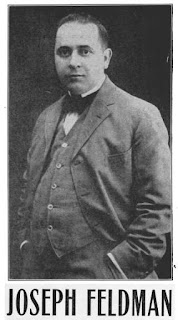
Joseph Feldman, Yiddish tenorThis song is described in the catalog as "comic," but without the second verse to set up the joke one might miss it. In the first verse we have the usual slightly mocking tone as true believers cluster lovingly around their spiritual leader at the end of the Sabbath - and they have the great honor to eat the leftovers from his feast.

In the second verse, which Feldman did not record, the rebbe's wife is holding forth among her friends with the same prayers for the end of the Sabbath, but when she hears her husband starting the final wrapup she comes running, and he takes her into the house and closes the door behind her for a little "holy havdole" of their own.

So that's what the distraught abandoned wife in the third verse is begging for, a little of that same holy havdole from the rebbe.

I love Joseph Feldman. The title on his 78 is Dem Rebbin's Havdoleh (Josef Feldman). Here's his recording:


Transliteration and translation from the Yiddish after the jump.

>>>>>READ MORE >>>>>

Labels: , , , , , ,