Researching Yiddish penny songs (tenement song broadsides of theater and variety show songs, 1895-1925)
About this project ♦ ♦ About Jane Peppler
List of the still-lost songs: do you know any of them?
Search the blog:

Tuesday, January 26, 2021

Shtoyst zikh on (Figure it out yourself) - Solomon Small sang it in 1910 and I sang it today.

UPDATE: The lyrics for two verses of this song were found in Solomon Small's own magazine of (primarily his own) Yiddish theater song lyrics, but it took a while to find the melody (on the recording you'll find below, which I bought on eBay). Updating because four years ago I had somehow mislaid my own version so today when I wanted to write it up for my "Yiddish pour tous" series, I had to sing it over again.

Also, Mordkhe Miller and Ri Turner helped me figure out the words to the third verse. I guess it was a little too risque to be printed on the sheet music. The music teacher and his beautiful student work on the piano, the verb is tsimblen which means play the cimbalom, strike the cymbals; make a racket, play boisterous music; thrash, beat and it sometimes is used for people beating on each other and it also is a rough synonym for banging, which would have been the cruder translation. Anyway, here's my recording from this morning:


And also to point out this song has the same "nudge nudge wink wink" theme as a song I posted in December: Dos iberike farshteyt aleyn (and the rest, you understand).

Now back to the real thing: I found the Smulewitz record on ebay. What a great orchestra! The song is by Arnold Perlmutter and Herman Wohl with words by Louis Gilrod. The singer is composer and performer Solomon Small (originally Solomon Smulewitz) but the song was originally out in 1909 featuring Bessie Thomashefsky - it's from Boris Thomashefsky's show Dos pintele yid (or as it says on the sheet music Das pintele yud). You'll find it spelled Shtoist sich on or Shtoist zikh on. I love this recording!


I'm sad the third verse (about, I assume, a lecherous piano teacher) is not printed in the sheet music. If anybody wants to figure it out I'd be grateful. Email me if you do.

The YIVO transliteration of the Yiddish and my translation after the jump.


>>>>>READ MORE >>>>>

Labels: , , , , , , ,

Wednesday, August 12, 2020

Sweet Rosie O'Grady: Yiddish Parody by David Meyerowitz of the famous Irish-American song for St Patrick's Day

UPDATE: I know there are a lot of people interested in cross-dressing performers of the vaudeville and music hall stage who will enjoy this picture I just found of Maude Nugent as a young woman:

Here's the track from our cd Yiddish Ragtime.


Here is another song from Lider Magazin - a Yiddish version of Maude Nugent's Tin Pan Alley Irish-American hit song of 1896. (You can hear her singing the original song on Youtube.)

Last March Randy Kloko, the bass who has sung with me on so many of these Yiddish projects, made an unexpected visit from Florida and he sang on this in time for St Patrick's Day 2019. He is a barbershop quartet expert and added the correct flair! Then we were able to put it on our new cd Yiddish Ragtime.

If you have been looking for a Jewish song to sing for St Patrick's Day, here it is.

Note that in the third verse it is revealed that Rosie is disrespected in society. I believe she is probably a chorus girl or an actress, it was a familiar trope of the day (actually still true) that boys of respectable families would fall in love with show biz dames.


Transliteration and translation from the Yiddish after the jump.


>>>>>READ MORE >>>>>

Labels: , , , ,

Sunday, March 15, 2020

Pinokl (Pinochle) - Morris Goldstein's Yiddish vaudeville hit of 1918

UPDATE: While sequestered at home due to the coronavirus I'm spending a little more time poking through Lider magazin and I found a song sheet for this Louis Gilrod song! Click for a larger view.


Allen Lewis Rickman wrote and asked if I'd post this song. I couldn't have done it without the transcription skills of Sam Weiss, who volunteered out of his esteem for Mr. Rickman!

I usually have to stick to songs for which there is either a broadside or sheet music because I'm not good at teasing out the lyrics of the old-time singers.

Here is Morris Goldstein singing:


I don't know anything about Morris Goldstein (though he has been featured on this blog several times before, you can put his name in the search box and see) and I also know nothing about pinochle except that my father and his brothers used to play it.

In Yiddish I've also seen it spelled pinakl, pinakel, pinokel, etc.

As usual, lots of double entendre here. Transcription and translation after the jump.


>>>>>READ MORE >>>>>

Labels: ,

Thursday, September 12, 2019

Cheap, Cheap, Cheap! Yiddish parody of the ragtime song "Gone, Gone, Gone"


Here's our recording of Cheap! from the cd Yiddish Ragtime, with Randy Kloko singing, me on fiddle and Glenn Mehrbach on keyboard:


The melody for this parody by Louis Gilrod is taken from "Gone, Gone, Gone," a ragtime song by T. J. Farron, Jr and Joseph M. Hollander. The song was sung by Russell & Locke:


It was about a man who lost his sweetheart, she was gone gone gone. Louis Gilrod turned this to a song about saving money. It mentions venereal disease more explicitly than any other song of the era. Transliteration and translation from the Yiddish after the jump.


>>>>>READ MORE >>>>>

Labels: , , , ,

Wednesday, September 11, 2019

Ven ikh volt gevezn president: a Yiddish parody to the tune of Pretty Little Dinah Jones


Here's our recording of Ven ikh volt gevezn prezident, from the cd Yiddish Ragtime.Randy Kloko is singing, Glenn Mehrbach is playing keyboard.


Isidore Lillien (Isidor Lilien etc) later had a very respectable career writing for the Yiddish theater, but here he put his hand to the work of writing Yiddish lyrics for currently popular American songs, in this case a gentle ragtime number by J. B. Mullen, published in 1902.

The original song is about a little maid in Florida's sunny clime. The parody is a fantasy based on complaints about life, problems that would be remedied by the speaker if he were to become president.

Lilien was born in Rzeszow (Reyshe), Galicia in 1882. He came to America with his family at the age of ten, joined a dramatic union at 16 and at 17 was working at a vaudeville house. Of interest to me: Zylbercweig wrote that Lillian's comedy "Gimpel Beynish der Shadkhn" was staged in 1911. I hadn't thought Gimpel was even invented until a year later.

The lyrics here give a rich detailed overview of immigrant life on the lower east side.

Oddly, the fourth verse is about Nicholas II and the pogroms. The song was long already so we decided to skip that verse.

Transliteration of the yiddish and translation after the jump.

>>>>>READ MORE >>>>>

Labels: , , , , ,

Thursday, August 22, 2019

Bizi bay cloaks: Yiddish vaudeville parody of "Down on the Brandywine" - fun in the garment business

We recorded "Bizi bay cloaks" on our Yiddish Ragtime cd.


Here's our recording with Randy Kloko on vocals and Glenn Mehrbach on keyboard:


The original American song was "Down On The Brandywine," written by Vincent Bryan and J. B. Mullen, published in 1904. Collins and Harlan did a lovely job in their recording of the same year, found on Youtube.

Louis Gilrod wrote his contrafactum playing on various meanings of the preposition "bay" - from a sweatshop full of people making coats in July to a pickpocket at the opera to a boarder working "overtime" at home with the landlady while her husband is at the shop.

Notice that "cloaks" rhymes with "ox" and "blocks" -


Yiddish lyrics in transliteration and translation after the jump.


>>>>>READ MORE >>>>>

Labels: , , , ,

Thursday, August 15, 2019

A bisele fun oybn (Yiddish parody of A Little Bit Off The Top) 1898 Yiddish parody of an American vaudeville hit


Here's our recording of a once-famous (perhaps) Tin Pan Alley Song written by Murray and Leigh, from our cd Yiddish Ragtime. Randy Kloko is singing, thanks Randy!


Louis Koppelman wrote this Yiddish parody of an American comic song of the same name. The lyrics of the original were silly (as befits "The Comic Rage") and so were Koppelman's verses.

In the second verse our protagonist complains that he went to the theater and paid for an expensive seat ($1.00) which is why, when a lady with a big hat sat in front of him, he couldn't see anything. If he'd been in the cheap seats in the gallery with the hoi-polloi, this hat would not have been a problem.

Also interesting: "Sappho" was playing. Was in in English or Yiddish? Was it famous at the time? I haven't bothered to find out.

By the way, big hats those days were really big.


Yiddish lyrics and translation after the jump.

>>>>>READ MORE >>>>>

Labels: , , , ,

Monday, August 5, 2019

Di muzik shpilt (1895 Yiddish parody of And The Band Played On)

The Band Played on, by Charles B. Ward and John F. Palmer, was one of the big successes on Tin Pan Alley, so of course it was parodied for the Jewish music publishing world. Isaac Reingold, who has featured often in this blog, was one of the two most prolific parodists (the other being Louis Gilrod).

This is an astonishing lyric. In the first verse, we get a sweet and detailed scene from young Genendl's life, when she leaves her preparations for the Sabbath behind in order to go dancing. In the second verse, Genendl and her fiance are at their wedding reception longing for everybody else to leave so they could be alone together. And in the third verse, the husband murders her for going on a picnic with the boarder.

Here's our take on it, from the Yiddish Ragtime cd. Randy Kloko sang with me and Glenn Mehrbach played the keyboard.


Transliteration and translation from the Yiddish after the jump.

>>>>>READ MORE >>>>>

Labels: , , , , , , ,

Friday, August 2, 2019

Di matbeye - Yiddish theater song of 1908 - די מטבעה

UPDATE: In March I wondered if this song were lost forever. It's a wonderful Yiddish take on "If You Ain't Got That Do-Re-Mi" !

Happily Lorin Sklamberg and Eléonore Biezunski at the YIVO Sound Archive found a recording of Solomon Smulewitz singing this song, his own composition, and I liked it so much we put it on our Yiddish Ragtime album even though it has nothing in common with the other songs. It is the only natively Yiddish composition on the disk.


דיא מטבעה
I originally found it in the Solomon Smulewitz publication Der teater zinger דער טעאַטער  זינגער

Click the image for a larger view.

It says at the top of the page, Gezungen fun Mr Katzman un fun Madam Raynhart.
געזונגען פֿון מר. קאַטזמאַן און פֿון מאַדאַם רײנהאַרט

Perhaps these are Jacob Katzman and Fannie Reinhart.

I love everything about this song, from its snide and discouraging tone to its dark advice and its interesting, long tune. But my favorite part is the Question-and-Answer period. When I recorded it with Randy Kloko I said: let's have those answers sound like they came from on high via the Magic Eight Ball.


Transliteration and translation from the Yiddish after the jump.


>>>>>READ MORE >>>>>

Labels: , , , , , , ,

Thursday, August 1, 2019

Gey shnel aheym - Yiddish parody of the Walter Wilson song "Ain't Dat A Shame"


The original song, Ain't Dat A Shame, published in 1901 by John Queen and Walter Wilson, was probably inspired by Frankie Baker, who in 1899 shot her man for going to a dance with another woman. She became the star of "Frankie and Johnny" and there are strains of the famous melody within this one. (In Ain't Dat A Shame, though, the philandering man thinks better of it and goes home, only to find she's locked the door, so nobody dies.)

The Yiddish parody written by Louis Gilrod probably began as just the title, which fit so nicely against the English language original. In the first verse a woman sends her suitor home; in the second verse a wife sends her gambling husband home; in the third verse a boarder sends his lovelorn landlady home.

Barb Coffman played the keyboard and Randy Kloko joined me on this song for our album Yiddish Ragtime

Here's our recording:


Transliteration and translation after the jump.


>>>>>READ MORE >>>>>

Labels: , , , , , ,

Wednesday, July 31, 2019

Vi gefelt aykh aza boarder? - a Yiddish minstrel show song.

UPDATE: Reposted for the updated video, using the track from our new cd Yiddish Ragtime and now including not just me and Bob Vasile (guitar) but also Randy Kloko (vocals) and Jack Herrick (mandolin).


This is one of my very favorite songs from the Lider magazin collection - and it's also my very favorite song about that iconic figure, the boarder: a single man who is renting a room in somebody's apartment and hanging out with the wife while the husband is at work. It seems like more than half the parlor songs from this time period are obsessing about boarders.


This says the song is from Zigmund Mogulesko's famous comedy "Di yidishe emigrantn, oder, der bigamist." The boarder in this song is, indeed, a bigamist, but we don't find out until the last verse.


The composer of this ditty is Nahum Meïr Schaikewitz ("Shomer") who rates an entry at Jewish Encyclopedia.com and Wikipedia but neither article references his work as a song parodist.

The original song, "How'd You Like To Be The Ice Man," published in 1899 by Helf and Moran, fascinates me. The narrator is convinced that icemen are as wealthy as Vanderbilt and are treated to perks like free groceries, free booze (a "Tin Roof Cocktail") and dinner on the house. It turns out, there was an "Ice Trust" roundly excoriated on the street. Here is the Ice Trust personified.


Transliteration and translation from the Yiddish after the jump. We didn't sing the third verse.

>>>>>READ MORE >>>>>

Labels: , , ,

Saturday, July 27, 2019

Tsurik, tsurik, tsurik in shnayder shop (Back, Back, Back to Baltimore) Yiddish ragtime from 1904


Isidore Lillian (left) (also spelled Isidor Lillien or any combination) was born in 1882 in Galicia. He came to New York in 1892 and was 22 when he wrote this parody for the Katsenelenbogen music publishing company.

I've been chewing away on the parodies printed in the Lider magazin found at YIVO (but sent to me by the superlative Vivi Lachs in London). It seems to me that Yiddish vaudeville ragtime is a genre ready for revival!

A problem is that the underlying songs often had racist lyrics; nobody in their right mind would sing them any more. I'm hoping it's ok to bring the melodies back without the baggage. In this case, unusually, the Yiddish lyric has the same theme as the original: that it's not a good career choice to go into show business. Back, Back Back To Baltimore, melody by Egbert Van Alstyne and original lyrics by Harry H. Williams, was published in 1904.

It was my great fortune to have pianist Glenn Mehrbach play the accompaniment and Randy Kloko sang on the chorus. Here's the track from our cd Yiddish Ragtime:


Transliteration and translation from the Yiddish after the jump.


>>>>>READ MORE >>>>>

Labels: , , ,

Saturday, March 2, 2019

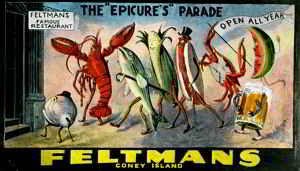
Mayn kales apetit (My fiancee's appetite) - Bill of Fare - Yiddish vaudeville song about gluttony at Coney Island

UPDATE: Reposting because I found this song in Lider magazin number 21, on page 10. And my guess (see below) was confirmed: though Sani Shapiro printed it as Mayn kales apetit WITHOUT an attribution of author, in the Lider magazin Louis Gilrod is named and the title is actually "Bill of Fare." Feeling pretty pleased to have my guess confirmed. Click on the images below for a larger view.
Here's the songsheet in the Hebrew Union College box:


And here's the same song from the Lider magazin:


Coney Island attracts Jewish immigrantsConey Island's excesses are the subject of this song, particularly the way cheerful Americans with a few pennies in their pockets could buy a staggering variety of foods. I think the lyricist was blown away by the public gorging, much as you would be today if you visited the North Carolina State Fair!

Mark Slobin had a copy of this broadside and wrote about it on page 105 of his Tenement Songs:
Of particular textual interest in this song of a lunch gone mad is the slow build-up of fantastic elements, which eventually acquire a surreal character: "roasted rain with cooked snow"; "bitter honey with sweet horseradish." ... What we are dealing with is a comment on the hurly-burly, hodge-podge nature of American life, where strange foods are bolted down indiscriminately."
I didn't think I'd be able to find the tune for this song. At the end of the introductory verse, though, appear the English words "Bill of Fare," and since when Yiddish lyricists wrote parodies of English language songs they often referenced the original song in some way...

...  I searched this title at the Library of Congress site and found two songs called "Bill of Fare." The song lyrics in the American Yiddish Penny Songs collection fit the 1885 song by Karl Merz which you can look at here. Here are his lyrics:

Lobster sauce and chicken fried, turtle soup and turkey boiled,
Roasted goose or mutton steaks, oysters stewed or flannel cakes
Chicken salad leg of lamb, fried potatoes and roasted ham.
Oysters pickled cabbage boiled, apple dumplings pigeons broiled
Beefsteak, salmon, onion sauce, roast beef, pork and codfish balls
Spinach lettuce radies, omelet, tongue and sausages!
Apple pie or butter cakes, custard cold or scrambled eggs
Salmon rolled or oysters fried, watermelon, cherries dried,
Orange cream or marmalade, gingerbread this morning made,
Coffee, tea, or lady cake, Ladies, Gents, what will ye take?

Since Bill of Fare is very similar to (though not as surreal as) Mayn vaybs apetit I decided to set the Yiddish words to this tune.

The arrangement available at the Library of Congress is for four equal voices. I rearranged it for three voices and sang them all myself. It would have been much better to have actual real people sing with me, but I don't know anybody I could ask to do it! It also would have been better if I'd done it at a studio where you can use automatic pitch correction! But it's what it is, another living room recording, the best I could do.


I imagine what an immigrant Jew of humble origins would think of the Merz Bill of Fare, and of the outrageous varieties of foods available on the streets and in the restaurants of Coney Island! America, you land of plenty!
>>>>>READ MORE >>>>>

Labels: , , , , ,

Tuesday, February 26, 2019

Mayn vayb's vunder (My wife's wonder) - a sarcastic parody of Abraham Goldfaden's "Gots vunder" by Isaac Reingold

UPDATE: Reposting because, delightfully, Leyzer Burko pointed out today on Facebook that kishke gelt (literally "guts money"), more specifically than my translation of "money that comes from sacrifice," is: "money you accumulate by scrimping on your meals."

A few days ago I posted a song recorded in 1919 by Marcus Eisenberg, Gots vunder - it's just a beautiful recording and an interesting song, the story of Passover told in quite an unusual way.

I actually love its tune, even though in general I'm addicted to interesting chord progressions and there are only two chords in this song.

There are two parodies of Gottes Wunder in the American Yiddish Penny Songs collection - one called "How the bosses oppress the workers," and this one...

... which explains how an ordinary shmo slaving away in a garment district sweatshop can pull himself together financially with the help of a wife who's smarter than he is. And in fact, he can live the American dream and become as rich and corrupt as anybody else. It's a free country, so saith Isaac Reingold, the lyricist.

There are several other parodies by Isaac Reingold, mostly great, on this blog: put his name in the search box and see.

So click to hear my recording from yesterday and today of Isaac Reingold's Mayn vaybs vunder:


And below, my translation. If you want the Yiddish songsheet, email me.

>>>>>READ MORE >>>>>

Labels: , , ,

Sunday, February 10, 2019

Mener, mener - written by Oskar Solomonescu for Pepi Littman

UPDATE: In a collection from YIVO of publications called Lider Magazin (sent to me by Vivi Lachs) I found another set of lyrics for this song ("sung by Madame Finkel"). If anybody cares I'll post a translation. Here it is, click for a larger view.


This tune was supposedly from a Goldfaden operetta called "Bais Duwed" of which I can't find mention online. I found the lyrics, along with Der Tsiferblat, at Harvard -- written out longhand in Yiddish cursive by the composer, Oscar Solomonescu, and notated: for Pepi Littman, New York. And what a great song it is! I just can't believe this amazing tune, found for me by Michael Aylward, sung here by the magnificent Frank Seiden: Menner Menner, von Bais Duwed

And here's my version, sung this morning (the first time I've tried singing since our wretched election).


The composer, Osias Solomonescu, was born April 1869 in Yasi, Romania, to poor, Orthodox parents. Orphaned early, and penniless, but blessed with a beautiful voice, he found a home in some Romanian Yiddish theater troupe, where he sang in the chorus and played children's roles. His first adult role was Benyominl in Goldfaden's "Podriatshik" and after that he began playing comic roles, especially dressing as and playing a woman. He came to American in 1901 and played at the Eldorado. He also worked as a stage manager and "episode actor" in the Bronx Prospect Theater and in Philadelphia's Orchard Street Theater.

He wrote many theater songs most of which he sang himself. While still in Romania he translated the one act "The Red Trousers," which was later shown in Yiddish variety houses. Zylberzweig: "Solomonescu was unique in the Yiddish actors' world with his humorous letters, in which he described that era of the Yiddish theater." I'll have to look for that.

I think it's quite interesting that Solomonescu -- an actor known for playing women's roles in drag --  wrote these two songs for Pepi, an actress known for playing men's roles in drag (or at least, she played women pretending to be men). Quite modern.

Back to Frank Seiden (of whom I have not found a picture) -- he was one of the earliest Yiddish recording artists in America. I love his records even though they're very scratchy. Peter Nahon via MachineWhisperer.com avers that Seiden "led a wild life, winning a bar in New York's bowery during a poker game and tending bar there after his recording career was over."

One sees at ancestry.com that he was born in 1861 or 1862 in Austria/Galicia, immigrated in 1876 and was naturalized in 1886. He had one wife, Rachael, and four children: Jacob, Eva, Amalia/Mary, Joseph. He was listed in 1900 in Manhattan as a phonograph dealer, in 1905 in Brooklyn as an actor, in 1910 as "Vaudeville" in 1920 he was retired or unemployed. He was perhaps the Frank Seiden who died September 1926 and is buried at Mount Hebron cemetery in Flushing, Queens.

I hope some descendant will get in touch at some point and email me his picture!

Words and translation after the jump.

>>>>>READ MORE >>>>>

Labels: , , , ,

Tuesday, May 29, 2018

Yiddish theater (and other) songs, new cd: Ikh bin busy

The strange name of this cd comes from one of my favorite Yiddish theater songs ever, written by Nellie Casman: Mr Malekh haMoves ikh bin busy! (Mr Angel of Death, I'm busy) in which she, a young and rising star, gets so sick she DOESN'T GO TO WORK (ie she is sick unto death because nothing kept those troupers from the stage) and subsequently tries to convince the Angel of Death she simply has too much to do to die. It's the title track of this cd, Ikh bin busy.

Only $7 and comes with a 19-page pdf file of the complete Yiddish lyrics in transliteration and my translations.

I also put two songs on this cd that I wrote as entries to the 2015 International Yidisher Idol competition in Mexico City. I won first prize with Ikh ken shoyn nit mithaltn, I was Grand Champion that year!

Click on the picture to visit the cd and have a listen.


Contents:

1. Mr Malekh haMoves ikh bin busy (Mr Angel of Death, I'm Busy) 04:58
2. Tsores iz keyn dayge nit (Trouble's Nothing to Worry About) 02:43
3. S'vet zikh shoyn oyspresn (It'll Iron Itself Out) 03:20
4. Ikh bin arayngegangen un zikh oysgedreyt (I Went In And Turned Right Around and Left) 03:02
5. Gotenyu, gib a drey dos redele (God, Turn the Wheel of Fortune) 02:33
6. Dem milshteyns faygn (The Millstone's Figs) 03:21
7. Yeder eyner straykt atsind (Everyone's On Strike Now) 02:55
8. Kompani (Company) 02:06
9. Men vet dir keyn sakh nit mitgebn in keyver arayn (You Can't Take Anything With You Into the Grave) 03:48
10. Az du kenst nit un veyst nit nemt men zikh nit unter (If You Don't Know How, Don't Try It) 02:53
11. Aza mazl afn Keyser (The Czar Should Have Such Luck) 03:50
12. Dos pastukhl (The Shepherd) from Bar Kokhba 04:17
13. Ikh ken shoyn nit mithaltn (I Can't Keep Up) 03:43


For sheet music and/or performances contact me: jane@mappamundi.com

Labels: , , , , , , , , ,