Researching Yiddish penny songs (tenement song broadsides of theater and variety show songs, 1895-1925)
About this project ♦ ♦ About Jane Peppler
List of the still-lost songs: do you know any of them?
Search the blog:

Wednesday, November 28, 2018

Reb Yidl, gib gelt! (Mr. Jew, give money!) - a song for exhorting the synagogue congregation to pay up.

UPDATE: Searching the Florida Atlantic University Yiddish music collection using just the term "Reb" (because all other words in this title could be spelled in other ways) I found a recording of the song, sung by G. Z. Weismann: Reb Jüdel gib Geld

The sheet music for this song (spelled "Reb Yudel gib gelt") came out in 1905 and as you see, the song was sung with great success by Rosa Klug at the Peoples' Music Hall. Music J. Davidoff, words A. Mesco [now I know he was Adam Mesco], arranged by Joseph Rumshinsky.

The National Library of Israel has a 78 of Pepi and Moritz Weinberg singing this song, but of course, you can't listen to it unless you fly to Jerusalem. 

When I first saw this text, I thought it was a sincere exhortation to pious Jews, saying that if you want the good things of Jewish culture and religion, you must pay what they're worth. But towards the end of the song the sarcasm becomes more evident, and frume yidn of my acquaintance assure me this is a tongue and cheek message: in the Jewish community nothing comes for free even if it should.

There are two slightly different verses on the sheet music.

Click below to hear the song as I recorded it today:


For sheet music and/or performances contact me: jane@mappamundi.com

Labels: , ,

Tuesday, December 26, 2017

Mayn vayb iz in der country, hurray! Yiddish theater song recorded by William Schwartz in 1919

Feast your eyes on the dishy singer William Schwartz. You can read about him at a post about one of his other songs: Oy oy di vayber. He's also the singer of Hit aykh, meydlekh!.

AKA Mein Weib is in der Country Huray! and Mein Weib is in der Country Hurray!

For decades this trope: working men sent their families out to "the country" (perhaps the Catskills) ostensibly for the healthier air and curative life - while they gloated to be at home on the Lower East Side without their wives to hold them back from favorite ... pursuits. The other side of this was men fearing the wives out in the country were having ... too good a time. Sometimes coming home pregnant.

Two more songs on this subject are Gevald di mantens (1923, Adolph King) and Mayn vayb kumt fun Zakopane (1929, a local favorite in Warsaw Poland)

So, this song: The first delight is the tune, a combination of a cake-walk and a march.

The second delight is the multitude of Yinglish words to wallow in, just feast your eyes on them after the jump!

Best of all is this: "Tsu hobn a vayb, dos iz der grester misteyk, ikh leb atsinder punkt vi Got in Passaic."

The original phrase (which I discussed here: In Odess) was: Men lebt vi Got in Odess, that is, "one lives as God lives in Odessa." It was used to describe a place where unbelievers and those intent on licentious behavior can cavort freely because God is paying no attention - and he's paying no attention because he's on holiday among them, and he's chosen Odessa as his dream destination because nobody will bother him there.

Here, Isidore Lillian has deemed Passaic, New Jersey to be the New World's Odessa. Hahahahaha.

(If my interpretation is wrong I'm sure somebody will correct me.)


Without further ado, have a listen!


This kind of awful (but wonderful to listen to) song came from the show of the same name by Joseph Rumshinsky (Rumshisky) and Boris Thomashefsky, at the National Theatre. The sheet music was published in 1918 and shows that Isidor Lillian wrote the words and Thomashefsky sang the song in the show with Kalman Juvelier. I couldn't find a recording of their duet. Words (transliteration from the Yiddish and translation) after the jump.

>>>>>READ MORE >>>>>

Labels: , , , , , , , ,

Thursday, September 14, 2017

A gut yor, A git yuhr zu alle leite, A gut masoldig yohr: Happy New Year!

Just when I was feeling so pleased with myself for helping a reader with Az men farzikht in s'iz git, the next day (today) somebody wrote and asked for this song, as the High Holidays are roaring in and he wanted to perform the song with his chorus.

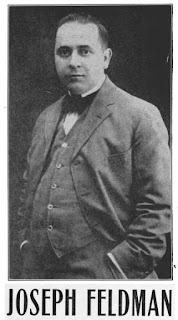
He'd found the Joseph Feldman 78 recording at the Library of Congress Jukebox under the name A Git Yuhr Zu Alle Leite (A Good Year to Everybody), but couldn't find the words.

I found the sheet music for him, also at Library of Congress but under a different title: A gut masoldig yohr (and inside the cover they spell it A gut maseldig yohr. It was published in 1915. Composer was David Meyerowitz (here spelled Myerowitz).

Feldman did not record the second verse, which is drenched in gloom.


Words and translation after the jump.

>>>>>READ MORE >>>>>

Labels: , ,

Sunday, May 21, 2017

Di havdole (Dem rebns havdole) Yiddish comic song recorded on Columbia by Joseph Feldman

Joseph Feldman, Yiddish tenorThis song is described in the catalog as "comic," but without the second verse to set up the joke one might miss it. In the first verse we have the usual slightly mocking tone as true believers cluster lovingly around their spiritual leader at the end of the Sabbath - and they have the great honor to eat the leftovers from his feast.

In the second verse, which Feldman did not record, the rebbe's wife is holding forth among her friends with the same prayers for the end of the Sabbath, but when she hears her husband starting the final wrapup she comes running, and he takes her into the house and closes the door behind her for a little "holy havdole" of their own.

So that's what the distraught abandoned wife in the third verse is begging for, a little of that same holy havdole from the rebbe.

I love Joseph Feldman. The title on his 78 is Dem Rebbin's Havdoleh (Josef Feldman). Here's his recording:


Transliteration and translation from the Yiddish after the jump.

>>>>>READ MORE >>>>>

Labels: , , , , , ,

Monday, October 10, 2016

Der amerikaner seder (The American Seder) as sung by Madame Littman at Agid's Clinton Street Variety House

UPDATE: Reposting to include the video I made today. A commenter had previously shown this to be a parodic version of a song called Der Seider (Der seder) or (as it was alternatively called on the inside front cover) Die Seider Nacht (Di seder nakht).

The sheet music cover says the music was by Hyman Altman and the lyrics by Adam Mesco. However, on the inside front cover it says, interestingly, "Words by A. Mesco. 1st verse and refrain by M. Zavodnik." This makes me wonder if the satirical version found in the American Yiddish Penny Song collection was actually the original, and that subsequently the song was adapted for some other use (perhaps in a show) and given a "straight" second and third verse by Mesco. Also interestingly, the Penny Song version just says the song is by Zavodnik. So did Zavodnik steal the tune from Altman or vice versa?

I really dragged my feet about recording this one. I found the Rumshinsky arrangement as given in the sheet music weird (you'll hear it on the first verse) and without a period recording I had trouble envisioning what the song was supposed to sound like. The tune goes best at a fair clip (the way I've recorded it) but that made the words go by too fast.

So I compromised and slowed down when there were a lot of words! This is the second keyboard accompaniment I've made by running a music notation software file into my Yamaha and recording the output on a second computer.


Below, the songsheet from the American Penny Song collection (translation at the bottom).

You can read about Max Zavodnick. Also read a bit about the Clinton Street Variety House: Sam Agid. "Madame Littman" is Pepi Litmann, who recorded quite a bit in Europe before coming to America.

Translation and song sheets after the jump.

>>>>>READ MORE >>>>>

Labels: , , , , , ,

Monday, May 9, 2016

New album available: Vos Hot Men Tsu Mir? (What Have They Got Against Me?) 17 gaslight Yiddish songs with texts and translations

I'm not sure I even really would call this an album, and I'm even more hesitant to call it a cd, because there will never be "physical product" and I didn't go into a studio to mix or master the tracks. They are just as you heard them first on this blog, warts and all... some are very warty because I had bronchitis for six months...

... my daughter and her husband don't even have anything in their house to play cds on any more (my son either). They only listen to mp3s. I guess that's the future...

Although this album has only a front cover, it comes with a 31 page pdf file of all the texts and translations. Click on the picture to visit it at our record label, Skylark Productions:


Contents:

- Dem bekers laydn (The Baker's Suffering)
- Di Terkishe Bulgarishe milkhome (The Turkish Bulgarian War)
- Di yesoymim (The Orphans)
- Di yidishe hofenung (The Jewish Hope)
- Dos mezuzele (The Little Mezuzah)
- Dos shop meydl (The shopgirl)
- Got zet ales un er shvaygt (God sees all and is silent)
- Ikh hob nisht keyn tsayt! (I don't have time)
- Ikh un mayn sheyne mishpokhe (Me and My Beautiful Family)
- Khaye Sores brif (Khaye Sore's letter)
- Kol Yisroel Khaveyrim (All Jews are Friends)
- Lebn zol Kolumbus! (Long live Columbus!)
- Mayn kales apetit (My fiancee's appetite)
- Mayn vayb's vunder (My wife's wonder)
- Vert a boarder! (Become a boarder!)
- Vos hot men tsu mir? (What do people have against me?)
- Vu nemt men a fraynd (Where does one find a friend?)


For sheet music and/or performances contact me: jane@mappamundi.com

Labels: , , , , ,

Wednesday, April 13, 2016

Gots vunder (Gottes wunder) - a Yiddish Passover song from Avrom Goldfadn's Melets Yoysher

UPDATE: reposting because Larry Gillig did me the favor of correcting my translation. And because Pesach is coming!


Gotes vunder doesn't properly belong here because, though its tune was used for two of the penny songs (here's one I recorded: Mayn vaybs vunder), it was not in the collection itself.

But it's almost Pesach and it's a Pesach song, so enjoy this beautiful 1919 recording shared with me by the Mayrent Collection at the University of Wisconsin, Marcus Eisenberg singing Gott's vunder for Victor records:


I went hunting for the lyrics and found them via Harvard's Hollis catalog. Afterwards Itzik Gottesman told me it can also be found as A mol hobn di yidelekh sheyn gelebt... in the Mloteks' "Pearls of Yiddish Poetry" (Perl fun der yidisher poezye).

Gottes wunder is the final song from the play Meylets yoysher, oder Rebe Yozelmann: a hisṭorishe opera fun di gzeyres̀ fun Elzas in 5 aḳṭen un 23 bilder by Abraham Goldfaden (1840-1908). Other spellings:  Rebe Yozelmann, Melits yosher, Rabbi Yoselman. Or, sadistically, on the fiddle part (which is all I could find online) it's spelled Malitz Josher. A מליץ־יושר is an advocate / defender / intercessor.

I didn't read the play itself, but you can if you like, it's on Google Books, you can even download it.

About the word ketsapikhis, Larry Gillig wrote:
It is a Biblical word used in the description of Mannah. Exodus 16:31
וַיִּקְרְאוּ בֵית-יִשְׂרָאֵל אֶת-שְׁמוֹ, מָן; וְהוּא, כְּזֶרַע גַּד לָבָן, וְטַעְמוֹ, כְּצַפִּיחִת בִּדְבָשׁ
ke-tsa-pi-khis (bi-dvash) usually translated as "wafers (made with honey)". (rhymes with "mi-yi-khes" if you use the "poylish" pronunciation of mi-yu-khes)
In the old days when most Jews who spoke Yiddish would have either known or at least or remembered their kheder lessons, the phrase would have been immediately recognizable, as it would be today to a khasidisher yid.

Here's the whole translation (not just the two verses Eisenberg recorded) - if you want the rest of the Yiddish email me.

>>>>>READ MORE >>>>>

Labels: , , , ,

Sunday, March 20, 2016

Oy der purim! A silly song for Purim by Morris Rund

I don't think I'm going to find the melody for this one, it says: "Sing to the tune of Di shkheynim" (The neighbors), I can't find that song either. This one reads like off-the-cuff rhymes for a party. As usual Morris Rund has a jaundiced view of the proceedings. But look how he advertises himself on the cover of the songsheet! (Click for a larger view.) The songsheet itself is at the bottom of this post.

It also says: "Sung with great success by Isidor Meltzer in the Peoples Music Hall."


From Mendele:
Probably from the Polish word "kolacz" (pronounced "kowatch") which comes from "kolo", meaning "wheel". This was a traditional Polish bread-like cake, round-shaped, and sometimes very big.

And from the Encyclopedia of Jewish Food:
A polish synonym for a very large braided oval challah of more than one and a half feet is variously spelled koyletsh, keylitsh, keylitch, koilitch, and koylatsh. [I also found the spelling kuilecz]
It is served at festive occasions, notably weddings and the Purim feast. At Polish weddings, a woman holding the koyletsh, sometimes with lit candels set into it, would dance (koyletsh tanz) solo in front of the seated bride and groom, conveying a wish that they might always have bread.

Wikipedia:
In cities that were protected by a surrounding wall at the time of the Biblical Joshua, Purim is instead celebrated on the 15th of the month of Adar on what is known as Shushan Purim, since fighting in the walled city of Shushan continued through the 14th day of Adar.


Oy der purim


There's a tumult everywhere, purim is coming soon
Every woman is involved with Purim now
They're all busy, it's no small thing
People are running, buying, doing everything to prepare for Purim!

Oy, Purim, it just causes misery
Every woman is sweating over the hamentashn there with the three points
For Purim!

My wife Mirke is terribly busy, she's running back and forth
She wants her Purim koyletsh to be just right
But suddenly, disaster, a lament, I beg you folks, just listen:
Her Purim koyletsh has risen too high, now it's worthless!

Khane Dvoshe's husband ran away a year ago
And now she's gotten a letter, he'll be here for Purim
So then she prepared Purim the day before
And suddenly her man arrives unexpectedly on Shushan Purim!

Chaim Khvatsh, a handsome Jew, I've known him quite a while
He gave his wife money to prepare for Purim
But suddenly he comes to me complaining and crying:
She's gone, she took Purim with her and left him alone!

My neighbor invited me to come to her the night of Purim
"I have," she said, "prepared a Purim with all the good stuff."
I thought what she was saying was all true
But what I found there, what a Purim, ugh, she should have such a year!

Sore Pesl took a ton of money from her husband
She ran out in the street and bought whatever she liked for Purim
She comes home and shows her husband the money she spent
The husband gets mad and says to her: you and Purim can burn!


A tuml iz yetst iberal, der purim kumt bald on
Yede froy oy hot atsind mit dem purim nor tsu ton
Zey zaynen ale 'bize' nor es iz keyn kleynikayt
Men loyft men koyft men tut alsding der purim zol zayn greyt!

Refreyn
Oy vey! Der purim, er makht nor on yesurim
Yede froy oy tut yetst shvitsn
Baym homen tosh dort mit dray shpitsn
Af Purim! Af Purim!

Mayn vaybl Mirke iz 'bize' a shrek zi loyft nor hin un her
Ir purim koyletsh zol gerotn dos iz ir bager
Nor plutsim oy a brokh a klog, ikh bet aykh mentshn hert:
Tsu yoyrn iz ir purim koyletsh, yetst hot er gor keyn vert!

Fun Khane Dvoshn iz antlofn shoyn a yor der man
Un yetst hot zi a brif derhaltn af purim vet er zayn
Ongegreyt hot zi dem purim mit a tog 'befor'
Un plutsim falt ir man arayn shushan purim gor!

Khaym Khvatsh a sheyner yid ikh ken im shoyn a tsayt
Gegebn hot er zayn vayb geld der purim zol zayn greyt
Nor plutsim kumt er gor tsu mir mit yomer un geveyn:
Avek iz zi un mitn Purim un im gelozt aleyn!

Mayn shkheyne hot mikh ayngeladn purim af der nakht
Ikh hob, zogt zi, gegreyt a purim mit aldem guts a prakht
Gemeynt hob ikh az vos zi zogt az dos iz ales vor
Nor getrofn hob ikh dort a purim zol zi hobn aza yor!

Sore Pesl nemt baym man a gantse bombe geld
Zi loyft in strit un koyft af purim vos nor ir gefelt
Zi kumt aheym un tsaygt dem man vos geld zi hot 'gespent'
Der man vert beyz un zogt tsu ir: ver mit dem purim farbrent!

Click for a larger view:

Labels: , , , ,

Monday, October 12, 2015

Fraytik af der nakht (one of the American Yiddish Penny Songs) (was Fraytig oyf der nakht)

Freitag auf der nacht sheet musicIn the Mlotek's Songs of Generations: New Pearls of Yiddish Song they note this song "first appeared in 1905 in sheet music without attribution to any author or composer." The sheet music, entitled Freitag auf der nacht and printed in London, England, attributes the arrangement to Fardinand Staub but does not give a composer. You'll also see fraytig, fraytog, etc.

(N.B. this is not the song by the same name composed by Nochem Sternheim.)

The words as printed in the sheet music are close to some of the words I learned at KlezKamp in the 1980s and which I recorded with pianist Aviva Enoch at our first concert in 2010 (click the picture to hear the youtube video):


Here's the broadside, click it for a larger view. The lyrics are exactly as printed in the sheet music.


The political cartoon which appears at the bottom of the songsheet is unrelated to the song but appears on the same page. It's signed by Romanian-born Sani Sapira (Sani Shapiro), publisher of most of these penny song broadsides.

Transliteration and translation are below. I have had it beat into me that "af" is now considered far preferable to "oyf" in transliteration but you won't find that choice in any records more than a few years old. I've used several variations to help in web searches. I think all the laughing inanimate objects are just there to rhyme with nakht and add a general air of jollity.

Fraytik af der nakht, az ikh kum nor fun di shul tsu geyn
Shteyt mayn vaybele un lakht, oy zi iz mole-kheyn

>>>>>READ MORE >>>>>

Labels: , , , ,

Saturday, April 11, 2015

Shtey oyf, mayn man! A parody of Goldfaden's Shtey oyf mayn folk (Yiddish theater song)

The songsheet (see below) sets the parody to "Goldfaden's famous song Shtey uf mayn folk." Here is the sheet music, which is at the Library of Congress website under the spelling Steh Auf Mein Folk.

In this published sheet music copyright 1902, I see Goldfaden takes credit for the words AND the music, though it ALSO says "by H. A. Russotta."

However, Goldfaden was a notorious thief. In Voices of a People, Ruth Rubin wrote that the title and original poetry, "in the spirit of Haskalah endeavors," were from an 1868 poem by Michl Gordon and Goldfaden used them without permission, "which sorely displeased the original author."

There is a transliteration and a rhyming English translation of the original original here: Mikhl Gordon's Shtey Oyf, Mayn Folk at the Jewish Daily Forward. Gordon rallies the 'unenlightened,' old-fashioned superstitious Jews: "Enough already with your sleeping, wake up and open your eyes... dress as everyone does, why are you wearing clothes like your great-grandfather?" There is actually a recording of this parody at the Florida Atlantic University site: G.Z. Weismann singing Steh auf mein Mann in Warsaw, Poland in 1908 (the words are different)


Here's me lip-synching to the recording I did with pianist Aviva Enoch, who works with Mappamundi in the Cabaret Warsaw project. My green screen worked better this time...


The parody has a wife scolding her husband for lying around while the other guys are hard at work at their sewing machines. (Click for a larger view.) I didn't think until I did this translation that takhtoynim (underpants or trousers) came from tukhes.

I only sang three of the verses, here are all five. Pishe-peyshe is a child's card game. The last verse gets pretty technical about poker and I needed some help figuring it out. Michael Wex wrote:
In context, it's clear that the khevre refers to his cronies. The meydlekh are queens. He's upset about the full house that Moyshe beat yesterday; he thinks that if he'd had one more ace [i.e., he had three aces in his full house], he'd have given him a pass [I'm not sure what this means; I always thought that to pass was the same as to fold] he's definitely got the four queens [with which Moyshe seems to have beaten his full house] on his mind.

Get up, my husband, pull on your trousers
And go look for a job already

>>>>>READ MORE >>>>>

Labels: , , ,

Sunday, April 5, 2015

Yaaka Hula Hickey Dula (Hawaiian Love Song) in YIDDISH. Yes, really.

UPDATE: Incredibly, available at the FAU site is another, DIFFERENT song (different melody and different lyrics), recorded by Jacob and Rose Silbert in 1916, called Der Yiddisher Yakahula Hickadula

In the Yiddish Penny Songs collection, among all the sad songs about death and labor movement struggles, there are a few outliers, and this is definitely one of them. Morris Rund wrote Yiddish lyrics to this song, in Yiddish it's Yaki Dula. It might be the most ridiculous song I've ever recorded.

The original song, with music by Pete Wendling and lyrics by E. Ray Goetz and Joe Young, was sung by Al Jolson in his show Robinson Crusoe, Jr. which opened at the Winter Garden Theater in February of 1916. You can also hear it as sung by Collins and Harlan on the Library of Congress Jukebox.

According to Wikipedia, in the show a millionaire falls asleep and dreams of going to Crusoe's island, with Al Jolson his chauffeur (in blackface) as his man Friday. There is a haunted forest and a pirate ship crewed by chorus girls. And this ludicrous song.


Here's my quick-and-dirty translation from the Yiddish:

Folks, hear the news, it's nothing bad
Boys and girls are all singing it these days:
Yaaka hula hickey dula, yaaka hula hickey du
Wherever you go, on every street
These days Jews and Christians are singing this song:
Yaaka hula hickey dula, yaaka hula hickey du
When a cantor is practicing for Yom Kippur, listen:
He's singing Unsane Tokef with this melody:
Yaaka hula hickey dula, yaaka hula hickey du

>>>>>READ MORE >>>>>

Labels: , ,